
Teaching compare and contrast sounds simple… until you’re standing in front of a classroom full of upper elementary students staring back at you like you just invented a brand-new language.
“Compare? Contrast? Wait… which one means same?”
If you’ve ever felt like students should understand this skill but somehow still struggle to apply it independently, you’re not alone. Compare and contrast is one of those foundational reading strategies that students revisit year after year — and yet many still need structured, repeated practice with clear models.
Over the years, I’ve learned that the biggest breakthrough comes when students work with paired passages rather than isolated texts. When they can see two stories side by side, the strategy finally clicks.
Here’s what’s working in my classroom (and why).
Why Compare and Contrast Is Harder Than It Looks
On paper, compare and contrast is a basic comprehension skill. In practice, it requires students to:
- Identify key details
- Track similarities and differences
- Organize information
- Use text evidence
- Explain their thinking in writing
That’s a lot of executive functioning wrapped into one lesson.
Many worksheets jump straight to the writing without enough modeling. Students end up guessing, copying random details, or writing vague responses like:
“They are the same because they are both stories.”
We want deeper thinking than that.
Students need structured exposure to paired texts that guide them toward meaningful analysis.
Why Paired Passages Work So Well
Paired passages create a natural framework for comparison.
Instead of asking students to remember two separate stories read days apart, the texts live side by side. Students can:
- Re-read easily
- Highlight key details
- Annotate similarities
- Track differences
- Refer back to the evidence
This reduces cognitive overload and allows them to focus on the thinking instead of the logistics.
When students work with two connected passages, they begin to notice patterns:
- Character choices
- Themes
- Settings
- Conflicts
- Author’s purpose
- Perspective
These observations lead to richer conversations and stronger written responses.
The Power of an Anchor Chart
One of the most effective supports for compare-and-contrast instruction is a consistent anchor chart.
Students don’t just need reminders — they need a visual thinking tool they can return to again and again.
A strong compare and contrast anchor chart helps students:
- Remember vocabulary
- Organize ideas
- Use academic language
- Structure their writing
- Stay focused during independent work
When paired passages are combined with a clear anchor chart, students gain confidence because they know exactly what is expected.
Predictability builds independence.
What Upper Elementary Students Need Most
By 3rd, 4th, and 5th grade, students are ready for deeper analysis but they still benefit from scaffolding.
Effective compare and contrast instruction should include:
- ✔ Modeled examples
- ✔ Guided practice
- ✔ Paired texts with clear structure
- ✔ Writing support
- ✔ Repeated exposure
- ✔ Academic vocabulary
- ✔ Visual anchors
- ✔ Independent practice opportunities
Students don’t master this skill from one worksheet. They master it through consistent, purposeful repetition.
That’s where high-quality paired passages make all the difference.
A Simple System That Actually Works
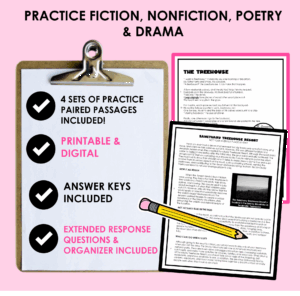
After years of trial and error, I created a set of paired passages specifically designed to support upper elementary learners. Each passage pair is structured to:
- Target compare and contrast skills
- Encourage text evidence
- Support writing responses
- Reinforce academic language
- Build confidence
Students aren’t just answering questions — they’re practicing a thinking strategy they’ll use across all content areas.
And the best part?
Teachers don’t have to reinvent the wheel every time they teach this standard.
You can grab the paired passages and anchor chart resource here:
Paired Passages on Marcy’s Mayhem
Paired Passages on TPT
It’s designed for 3rd, 4th, and 5th grade classrooms and works perfectly for:
- Whole group lessons
- Small group instruction
- Reading centers
- Intervention
- Test prep
- Homework
- Sub plans
Final Thoughts
Compare and contrast shouldn’t feel like a constant uphill battle.
When students have the right structure, the right texts, and the right supports, the strategy becomes second nature.
Paired passages give students the clarity they need to think deeply instead of guessing. And when the thinking becomes clear, the writing follows.
That’s when you know it’s working.
You can also find me on TPT ➔ Marcy’s Mayhem
& on ETSY ➔ Marcy’s Mayhem
Copyright © Marcy’s Mayhem
All rights reserved by the author. Permission to copy for single-classroom use.